

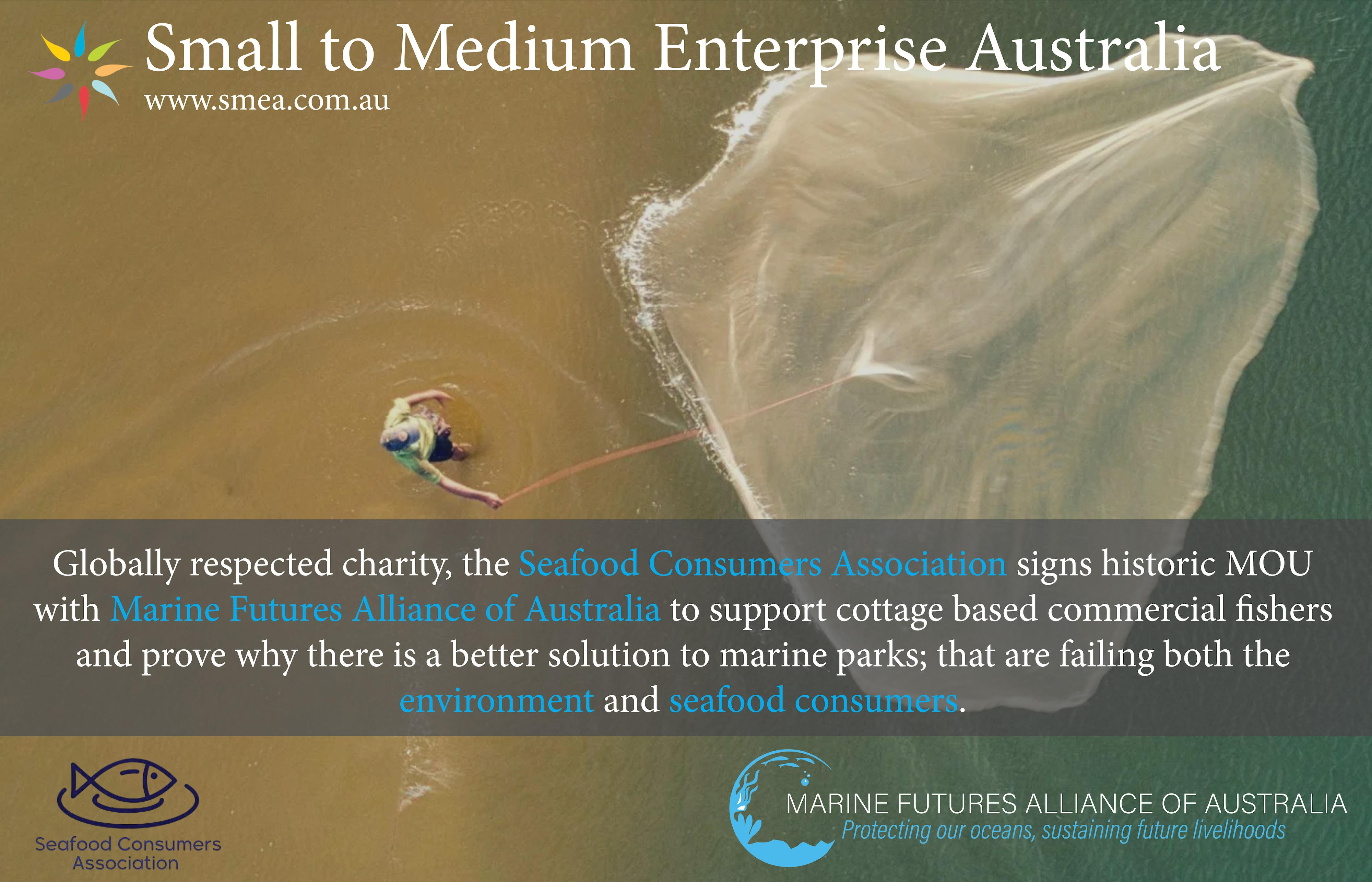
Small to Medium Enterprise Australia (SMEA) and the Seafood Consumers Association (SCA) today announced the signing of a landmark Memorandum of Understanding (MoU) aimed at unifying the marine sector and advocating for science-based management of Australia’s oceans. The partnership establishes a strategic front to address the growing economic and social impacts of large-scale marine park closures on local businesses and everyday consumers.
The collaboration is a direct response to recent policy decisions, most notably the Western Australian Government's move to permanently close 900km of coastline to commercial demersal fishers as of 1 January 2026 and the Victorian Government’s move to eliminate commercial fishing and aquaculture by placing the portfolios in Outdoor Recreation Victoria by July 2026.
The WA decision, implemented through a $20 million compulsory buyout, has highlighted a critical disconnect between environmental policy and the realities of food security, the health of the community and industry viability.
Advocating for Growth Over Decline
The MoU marks the formal support of the SCA for the Marine Futures Alliance of Australia, an initiative dedicated to ensuring that marine policy balances sustainability with the livelihoods of those who depend on the sea.
Dean Logan, CEO of SMEA, emphasized that the current "terrestrial-based paradigm" of locking up marine areas is failing both the environment and the economy.
"For too long, marine parks have been used as a political strategy rather than a scientific tool," said Dean Logan. "We are seeing a monumental policy failure where 46% of Australia’s Commonwealth marine environment is closed or restricted, yet we are still seeing drastic, uncoordinated closures that devastate small businesses. In Western Australia, while closures expand, consumers are seeing Kingfish fillets retail for $115 per kg! This is unsustainable. Our goal with the Marine Futures Alliance is to shift the conversation toward superior management aligned to science and incorporating all stakeholders rather than listening to the loudest voices and throwing away the key."
Protecting the Plate: A Consumer Crisis
The partnership highlights the severe "flow-on" effects that commercial fishing closures have on the recreational and retail sectors. Data from previous closures in Queensland and New South Wales show a 35.9% decline in full-time equivalent marine sector employees and a 25% downturn in retail output across recreational fishing trade portfolios.
Peter Wright, Chairman of the SCA, noted that these policies are pricing Australians out of their own local seafood. "Food security is a national priority that is being ignored," stated Peter Wright. "In New South Wales alone, we now import over 82% of our seafood. By partnering with SMEA, we are giving a voice to the millions of seafood consumers who want healthy, sustainable, and affordable local produce. We need to stop the 'recreational versus professional' fisher narrative; it serves no one. Likewise, the fisher v aqua farmer issue. When the commercial sector is squeezed, the entire supply chain, from the local tackle shop to the family dinner table, suffers."
Key Objectives of the MoU
The SMEA and SCA have agreed to collaborate on several high-priority areas to revitalize the "Blue Economy".
- Science Over Politics: Advocating for marine management based on rigorous economic and social feasibility studies rather than political agendas.
- Food Security & Traceability: Promoting the importance of locally sourced seafood and ensuring consumers have access to transparent, sustainable food sources.
- Joint Advocacy: Using their combined influence to challenge the "animal rights agenda" that often underpins large-scale closures without considering human impact.
- Resource Sharing: Combining data and research to professionally and scientifically argue for better management regimes.
A Call for Unity
The alliance seeks to replicate the success of previous cross-sector platforms, bringing together recreational anglers, commercial fishers/farmers, boat builders, and hospitality, chefs and foodservice. The parties believe that an adaptive, systems-based approach is the only way to ensure future generations can enjoy both a healthy ocean and a thriving marine industry.
"The future remains bleak if we do not act now," concluded Dean Logan. "Unity is our only path forward. We are committed to a future built on growth and access, not managed decline."
Comments
test
13 May 2026, 09:14 AM
'
test
13 May 2026, 09:14 AM
test'
test'
12 May 2026, 07:32 PM
test
test
08 May 2026, 05:53 AM
'
test'
08 May 2026, 05:53 AM
test
'
07 May 2026, 12:39 PM
test
test
07 May 2026, 12:39 PM
test
test
07 May 2026, 12:39 PM
test'
'
05 May 2026, 12:18 PM
test
test
05 May 2026, 12:18 PM
'
test
05 May 2026, 12:18 PM
test'
test
04 May 2026, 10:42 PM
test
test
29 Apr 2026, 10:20 PM
test'
test
29 Apr 2026, 10:20 PM
'
test
29 Apr 2026, 10:20 PM
test
'
29 Apr 2026, 10:20 PM
test
test
25 Apr 2026, 07:17 AM
test'
test
25 Apr 2026, 07:17 AM
test
test'
25 Apr 2026, 07:17 AM
test
test
24 Apr 2026, 04:36 AM
test'
test'
24 Apr 2026, 04:36 AM
test
test
24 Apr 2026, 04:36 AM
test
test'
23 Apr 2026, 05:35 PM
test
test
23 Apr 2026, 05:35 PM
test'
test'
23 Apr 2026, 01:32 PM
test
test
23 Apr 2026, 01:32 PM
test
test
23 Apr 2026, 01:32 PM
test'
test
23 Apr 2026, 11:31 AM
test'
test
23 Apr 2026, 11:31 AM
test
test'
23 Apr 2026, 11:31 AM
test
test
23 Apr 2026, 04:06 AM
test'
test
23 Apr 2026, 04:06 AM
test
test
23 Apr 2026, 04:06 AM
test'
test'
23 Apr 2026, 04:06 AM
test
test
23 Apr 2026, 04:06 AM
test
test
21 Apr 2026, 08:50 AM
test'
test
21 Apr 2026, 08:50 AM
test
test'
21 Apr 2026, 08:50 AM
test
test
20 Apr 2026, 12:36 PM
test'
test'
20 Apr 2026, 12:36 PM
test
test
20 Apr 2026, 12:36 PM
test
test
20 Apr 2026, 08:46 AM
test'
test
20 Apr 2026, 08:46 AM
test
test'
20 Apr 2026, 08:46 AM
test
test
19 Apr 2026, 08:29 PM
test'
test
19 Apr 2026, 08:29 PM
test
test'
19 Apr 2026, 08:29 PM
test
test
18 Apr 2026, 11:27 AM
test'
test
18 Apr 2026, 11:27 AM
test
test'
18 Apr 2026, 11:27 AM
test
NkJdTRRENvtknZIEcPW
12 Feb 2026, 07:19 PM
YoeZjFzLjlNLnNJlE
TwEuXFfnoxDThmeZJ
27 Jan 2026, 06:16 AM
RVIXZEubwnUFmAgsfTl
rDAKKkwJOjYJRwmApaUtpdZ
18 Jan 2026, 02:10 AM
viSFIYOsqlcodVltAqFw