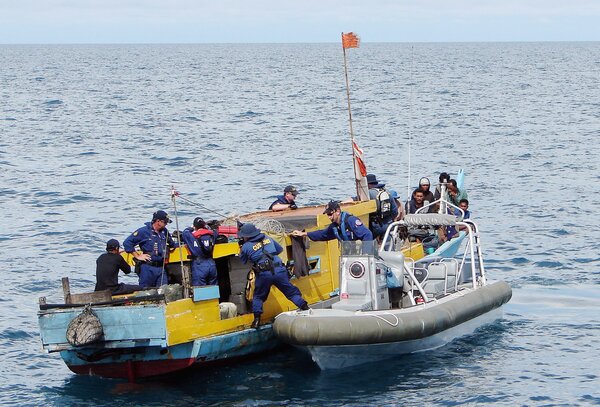
Illegal fishing, labour exploitation and seafood fraud cannot be tackled by watching fishing vessels alone. The businesses supporting those vessels also have a role to play in building a trustworthy seafood supply chain.
When consumers purchase seafood, they rarely think about the complicated network of businesses and services that made that purchase possible.
Behind every fishing vessel may be a network of fuel suppliers, port agents, repair contractors, refrigerated transport operators, insurers, financiers, logistics companies and other service providers.
These businesses are essential to legitimate fishing. But what happens when their services are used by vessels involved in illegal, unreported or unregulated (IUU) fishing, or by operators associated with serious labour abuses?
That question deserves much greater attention.
A recent international webinar, Behind the Fleet: Leveraging Service Providers for Effective Fisheries Governance, highlighted the importance of looking beyond the vessel itself when addressing fisheries governance. The accompanying resources emphasised risk assessment, enforcement, vessel information and due diligence by maritime service providers.
For the Seafood Consumers Association (SCA), the implications extend all the way to the seafood counter.
The hidden infrastructure of fishing
A fishing vessel cannot operate indefinitely in isolation.
It needs fuel, equipment, maintenance, supplies, access to ports and markets, and financial and logistical support.
These relationships create potential opportunities for verification and accountability.
Service providers may be able to identify the vessels with which they do business, establish who controls them, examine relevant authorisations and consider whether there are credible indicators of illegal fishing or labour exploitation.
The objective is not to assume that every business servicing a fishing vessel is responsible for that vessel's conduct.
Rather, it is to recognise that businesses providing essential services can be important participants in responsible fisheries governance.
If a vessel is subject to credible warnings about illegal fishing or serious labour abuses, should businesses continue providing services without undertaking appropriate checks?
That is a legitimate question for regulators, industry and consumers.
Illegal fishing and labour exploitation are connected concerns
Discussions about seafood sustainability have traditionally concentrated on fish stocks, habitats, fishing methods and environmental impacts.
These remain critically important.
But the people catching the seafood matter too.
Fishers working far from home can be vulnerable to abusive recruitment arrangements, withheld wages, excessive working hours, restrictions on movement and other forms of exploitation.
A seafood product may come from a fishery with environmental credentials while serious questions remain about employment conditions aboard individual vessels.
This illustrates an important distinction: environmental sustainability, legal compliance, labour rights and product authenticity are related, but they are not interchangeable assurances.
Consumers deserve to understand what any certification, claim or label actually verifies—and what it does not.
Follow the fish, but also follow the services
Seafood traceability commonly focuses on the product's journey from capture or harvest through processing, distribution and retail.
That is necessary, but it may not tell the whole story.
A more complete integrity system could also consider the supporting commercial relationships that enable fishing operations.
Who owns or controls the vessel?
Is it appropriately authorised?
Are there credible enforcement findings or outstanding restrictions?
Who is providing services, and what checks are appropriate before doing so?
What evidence supports claims about the fish, the fishing operation and the people involved?
These questions do not imply that all information should be publicly disclosed without restriction. Commercial confidentiality, privacy, due process and the reliability of evidence must be respected.
Nevertheless, better risk-based due diligence could help prevent problematic operations from moving unnoticed through otherwise legitimate commercial networks.
An Australian responsibility
Australia has a substantial interest in maintaining the integrity of seafood supply chains, both domestic and imported.
Our seafood reaches consumers through a mixture of local fisheries, aquaculture production and international trade.
This means that Australian businesses, regulators, buyers and consumers can all be affected by weaknesses in fisheries governance elsewhere.
SCA believes Australia should examine how vessel-risk information, fisheries enforcement intelligence and appropriate service-provider due diligence can contribute to stronger seafood integrity.
Particular attention should be given to how existing regulatory and commercial systems could work together more effectively, without imposing unnecessary burdens on responsible operators.
The aim should be practical prevention, not simply detecting misconduct after seafood has entered the marketplace.
Where I-CADMUS fits
SCA's developing I-CADMUS initiative provides a useful framework for examining these issues.
I-CADMUS addresses seven interconnected categories of seafood deception and misconduct:
- I — Illegal
- C — Counterfeit
- A — Addition/Adulteration
- D — Dilution
- M — Misrepresentation/Mislabelling
- U — Unreported/Unregulated/Undisclosed
- S — Substitution
The service-provider question is particularly relevant to illegal activity and unreported, unregulated or undisclosed conduct.
It also demonstrates why seafood fraud and supply-chain integrity cannot be understood solely by examining a finished product. A recent Codex meeting in Perth spent some time on the subject - Codex | CCFICS28
A fish may be correctly identified by species, accurately weighed and properly labelled, yet still be associated with serious questions about the legality of its harvest or the treatment of workers.
Conversely, evidence of a problem in one part of a supply chain should not automatically be treated as proof of every other type of misconduct.
That is why I-CADMUS emphasises evidence, classification, verification and proportionate responses.
From voluntary responsibility to meaningful accountability
There is growing recognition that fisheries governance must extend beyond the traditional relationship between regulators and fishing vessels.
Service providers are not substitutes for government enforcement. Nor should they be expected to investigate allegations beyond their competence or legal authority.
However, reasonable checks, clear risk indicators, reliable vessel information and appropriate escalation procedures could make them valuable contributors to prevention.
SCA sees opportunities for international collaboration, professional education and practical guidance that helps legitimate businesses recognise warning signs and respond responsibly.
The challenge is to develop systems that are proportionate, evidence-based and capable of supporting both responsible fishing businesses and consumer confidence.
The consumer must not be forgotten
Consumers cannot personally investigate every vessel, supplier or service provider behind the seafood they buy.
They depend on governments, businesses, professional organisations and assurance systems to perform their respective responsibilities.
That dependence creates an obligation to communicate clearly about what is known, what has been verified and where uncertainty remains.
Seafood integrity is not simply about knowing which fish is on the plate. It is also about understanding whether the systems that brought it there can be trusted.
If we are serious about rebuilding consumer confidence, we must look not only at the fishing fleet, but also at the networks that keep it operating.
Because the journey to trustworthy seafood begins long before the fish reaches the market.
Seafood Consumers Association Ltd (SCA) is an independent Australian registered charity advocating for safe, healthy, affordable, sustainable and trustworthy seafood.
Further information: The webinar Behind the Fleet: Leveraging Service Providers for Effective Fisheries Governance and its accompanying resources on vessel information, fisheries risk assessment and labour due diligence informed this commentary.
SCA: www.seafoodconsumers.global
I-CADMUS: www.i-cadmus.org
Comments
No comments yet.