
Allergies, octopus, seaweed, seafood integrity, marine medicines and the people behind Sydney Fish Market — another week looking at aquatic foods through the eyes of consumers.
Welcome to this week's Seafood in Focus from the Seafood Consumers Association Ltd (SCA).
One of the fascinating things about seafood is just how many subjects it touches.
Health. Nutrition. Biodiversity. Food safety. Science. Sustainability. Consumer trust. Culture. Jobs. Food security. And, of course, the simple pleasure of eating good seafood.
This week's stories demonstrate that extraordinary breadth.
Seafood Allergies & Allergens — New SCA Consumer Resource
Seafood should be enjoyable, nutritious and accessible — but for people living with food allergies, knowing exactly what they are eating can be critical.
SCA has created a new Seafood Allergies & Allergens information page to help consumers better understand seafood allergy risks and the importance of accurate information when purchasing or ordering seafood.
Seafood allergy is another reason why correct species identification, accurate labelling and good communication throughout the seafood supply chain matter.
For someone with an allergy, asking questions about ingredients, preparation and possible cross-contact is not being difficult — it is an important part of managing risk.
The new resource complements our existing consumer information on seafood allergies and forms part of SCA's continuing work to make reliable seafood information easier for consumers to find and understand.
Explore the new Seafood Allergies & Allergens resource:
https://seafoodconsumers.global/seafood-allergies.php
Related SCA information:
https://seafoodconsumers.global/media_details.php?id=41
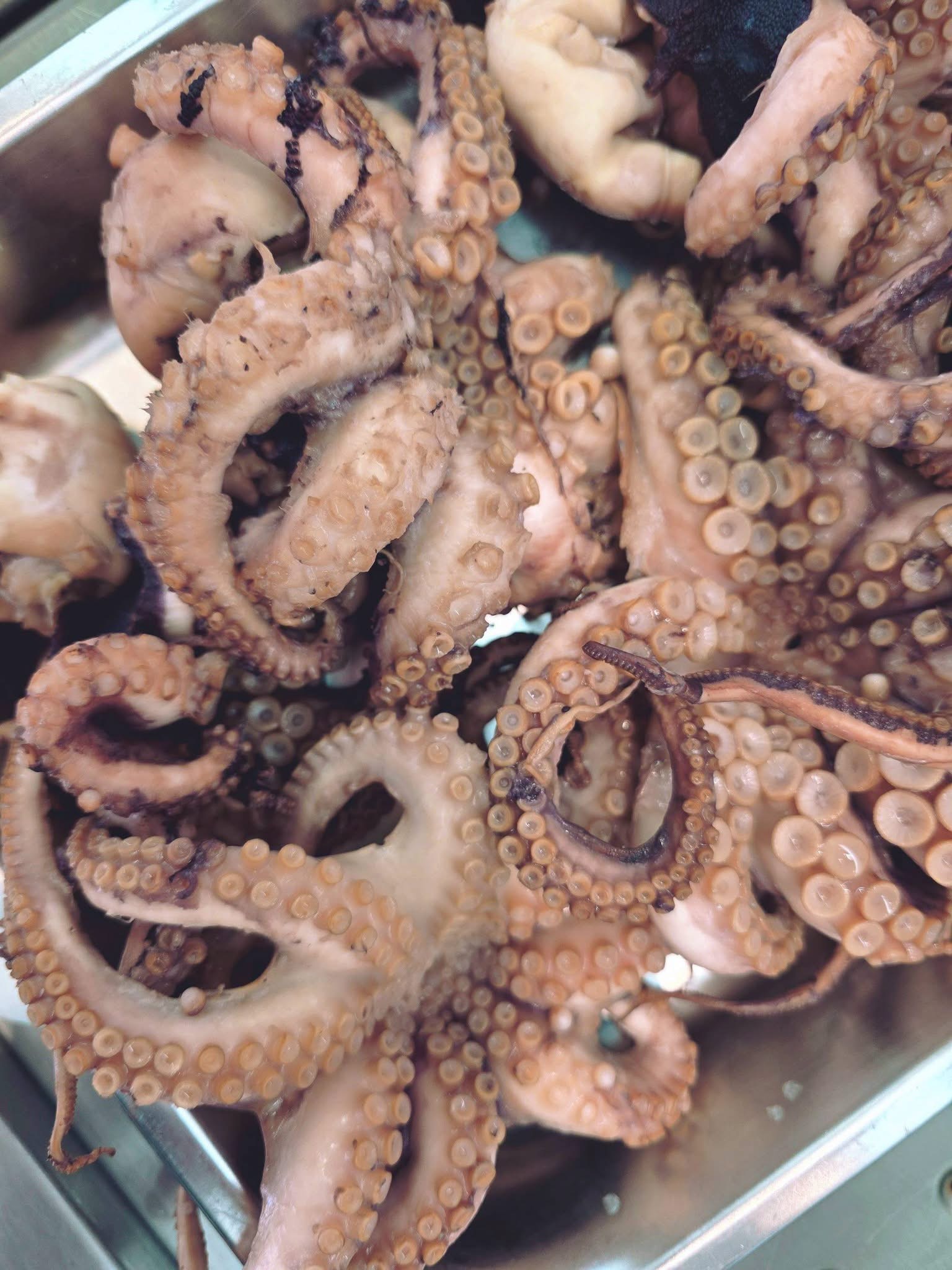
World Octopus Day — An Extraordinary Animal and an Important Seafood
On 8 October we celebrated World Octopus Day, giving us an opportunity to look more closely at one of the most fascinating animals in our oceans.
Octopus occupy an unusual position in our relationship with aquatic foods.
They are highly adaptable and behaviourally complex animals, but they are also important seafood in many cultures and support commercial fisheries around the world.
That makes the discussion surrounding octopus much more interesting than simply asking whether we should or shouldn't eat them.
We need to understand the species, how they are harvested, how fisheries are managed and how changing demand may affect them.
As consumers become increasingly interested in where seafood comes from and how it is produced, octopus provides an excellent example of why seafood choices benefit from knowledge rather than assumptions.
Read our World Octopus Day article:
https://seafoodconsumers.global/blog-detail.php?id=263
Seaweed — Are We Leaving Part of the Blue Economy in the Water?
When Australians think about seafood, most of us immediately think about fish, prawns, oysters, mussels or perhaps octopus.
But aquatic foods are much broader than animals.
This week we turned our attention to seaweed.
Globally, seaweed is already a significant food and aquaculture industry. Australia possesses enormous natural advantages, scientific capability and extensive marine resources, yet our commercial seaweed sector remains comparatively small.
That raises an intriguing question:
Are we leaving part of Australia's Blue Economy in the water?
Seaweed offers opportunities extending beyond food into nutrition, agriculture, biomaterials and other emerging industries.
But opportunity needs to be accompanied by sound science, appropriate regulation, environmental responsibility, investment and viable markets.
For SCA, there is another important dimension.
If Australia wants consumers to embrace a wider range of aquatic foods, we need to broaden the conversation beyond the handful of seafood species most Australians routinely purchase.
Read: Australia's Seaweed Opportunity:
https://seafoodconsumers.global/blog-detail.php?id=264
Inside Sydney Fish Market — The People Behind the Seafood
This week SCA spoke with filmmaker Dan Walkington, Series Producer of the new SBS/BBC Studios documentary series Inside Sydney Fish Market.
Dan entered the project knowing very little about the seafood industry.
What he discovered surprised him.
His first filming experience involved heading offshore from Yamba on an overnight prawn trawler — leaving around 5 pm and returning the following morning after seeing firsthand the physical work involved in putting seafood onto Australian tables.
But perhaps his biggest discovery was that seafood is ultimately a people business.
Fishers, wholesalers, retailers, families, chefs, scientists and market workers all appear along the journey from ocean to plate.
Dan also discovered the extraordinary diversity of seafood available to Australians — and how easy it is for consumers to repeatedly default to the same familiar species.
His experience has changed the way he buys seafood himself.
His advice to consumers is refreshingly straightforward:
Visit a good fishmonger. Ask questions. And occasionally try something you've never eaten before.
The series also highlights something SCA has discussed repeatedly — the considerable disconnect between consumers and the people who produce their seafood.
If we want Australians to understand and value seafood, the industry needs to become better at telling its story.
Inside Sydney Fish Market premiered on SBS and SBS On Demand on 8 October.
Read our interview with Dan Walkington:
https://seafoodconsumers.global/blog-detail.php?id=265
Seafood Integrity Watch — Following the Fish and Following the Money
Illegal seafood doesn't stop being a problem when the fishing vessel reaches port.
The I-CADMUS Global Seafood Integrity Watch for September 2026 examines how illegal fishing, document fraud, weak traceability and black-market trading can undermine legitimate seafood businesses and consumer confidence.
Drawing on developments from Australia and overseas, it demonstrates why seafood integrity needs to extend throughout the supply chain.
One of its central messages is particularly important:
The ocean may be where illegal seafood begins. The market is where illegal fishing gets paid.
I-CADMUS provides a framework for understanding seafood integrity risks across seven categories:
Illegal — Counterfeit — Addition/Adulteration — Dilution — Misrepresentation/Mislabelling — Unreported/Unregulated/Undisclosed — Substitution.
Detecting illegal fishing is only part of the solution.
Consumers ultimately need confidence that the seafood reaching their plates has been legally harvested, accurately identified and properly represented.
Read the September I-CADMUS Global Seafood Integrity Watch:
https://i-cadmus.org/news-integrity-watch-sep-2026.php
Molluscs, Medicine — and Why Marine Biodiversity Matters
An intriguing health-related story emerged from Radio Marinara's recent conversation with Professor Kirsten Benkendorff of Southern Cross University, whose interdisciplinary research combines marine biology and chemistry.
Professor Benkendorff explained how her work on marine molluscs began with a deceptively simple conservation question: if scientists were searching marine organisms for potentially useful pharmaceutical compounds, how could they do so without damaging the populations they were studying?
That required first understanding where species lived, how abundant they were and where they reproduced.
Her subsequent research on dog whelks — marine snails related to species historically used to produce the famous Tyrian purple dye — identified fascinating brominated compounds with antimicrobial properties and potential as leads for antibiotic and anticancer research.
It is a wonderful reminder that the value of healthy oceans extends well beyond the seafood immediately on our plates.
Marine biodiversity can also be a library of chemistry that we have barely begun to understand.
Protecting species and understanding their ecology may therefore preserve opportunities for future medicines and other beneficial discoveries that we do not yet know exist.
Around the Traps
Women's Health — Putting Seafood on the Agenda
SCA is preparing a contribution to the Australian Senate inquiry into women's health, looking particularly at the place of seafood and aquatic foods in women's nutrition and preventive health.
The inquiry provides an opportunity to consider seafood across different stages of women's lives — including pregnancy and breastfeeding, healthy ageing and general wellbeing — as well as practical barriers that can prevent people eating more seafood, including affordability, accessibility, food knowledge and consumer confidence.
Our starting point is simple:
If Australia is serious about improving women's health through nutrition and prevention, nutritious aquatic foods deserve to be part of that conversation.
We will report further on SCA's submission and recommendations once completed.
Healthy Fish Need Healthy Water
SCA is also examining an issue that started with a relatively straightforward question and is rapidly becoming a much larger conversation:
Can we have healthy fish without healthy water?
We are gathering evidence and speaking with Australian researchers and organisations working across pesticide monitoring, aquatic animal health, ecotoxicology, estuarine science, environmental chemistry and food safety.
The issue is not about taking an anti-pesticide position.
It is about understanding what happens when agricultural and other chemicals move beyond their intended use and enter creeks, rivers and estuaries — the same aquatic environments supporting biodiversity, fisheries and aquaculture.
One of the questions emerging from this work is whether water quality itself should be more explicitly recognised as fisheries habitat.
Fisheries management quite properly considers stocks, catches, fishing pressure and physical habitat.
But fish, prawns, oysters and other aquatic animals also experience the chemical environment of the water in which they live.
There is much more work to do before drawing conclusions.
For now, we are asking questions, gathering evidence and listening to the scientists.
There will be considerably more to come.
Looking Ahead — Consumers at the Centre
Work is also progressing on an international webinar discussion examining the future of aquatic foods from an often-overlooked perspective:
The consumer.
Using themes emerging from Sea of Deception — Understanding Seafood Fraud and Rebuilding Consumer Trust, SCA is developing a conversation around what consumers need if we genuinely want them to eat more aquatic foods.
How do consumers know what species they are buying?
Can they trust claims about origin and production?
Why do so many people repeatedly buy the same small number of familiar species?
What stops consumers eating more seafood?
And have we invested enough in helping consumers understand aquatic foods?
The underlying proposition is straightforward:
The future of aquatic foods will not be determined solely by how much seafood we can produce. It will also depend on whether consumers understand it, trust it, can afford it — and want to eat it.
More on this shortly.
The Common Thread — Knowledge Builds Confidence
At first glance, seafood allergies, octopus, seaweed, television documentaries, seafood fraud, marine medicines, women's health and water quality may appear to have little in common.
But there is a thread connecting every one of them.
Knowledge.
Consumers need to understand what seafood is.
They need accurate information about species and ingredients.
They need confidence in where products came from and how they were produced.
They need help discovering unfamiliar aquatic foods.
They need reliable information about nutrition and health.
And they need opportunities to understand the extraordinary people, science and environments behind what eventually appears on their plate.
That is how we move from simply putting seafood into the marketplace to creating informed and confident seafood consumers.
Hook and Sinker
Seafood can sometimes appear complicated.
Hundreds of species. Different names. Wild and farmed production. Australian and imported products. Sustainability claims. Allergens. Nutrition. Traceability. New aquatic foods.
But the answer isn't to give consumers less information.
It is to give them better information — clearly, accurately and in language they can use.
And perhaps Dan Walkington's experience provides the simplest advice of all:
Ask questions. Talk to the people who sell seafood. Try something different occasionally.
Because the more we understand our aquatic foods, the more confident we can become in choosing and enjoying them.
Know your seafood. Ask questions. Try something different. And enjoy the extraordinary diversity our aquatic-food world has to offer.
Comments
No comments yet.