
Trust on the plate
This week connects four issues that are often discussed separately: what seafood really is, how it is produced, whether it reaches us legally, and whether public policy helps consumers make healthier and better-informed choices.
We took an unplanned one-week pause while completing the final stages of Sea of Deception and dealing with an unexpected health interruption. Thank you for your understanding. We are pleased to be back—and there is plenty to report.
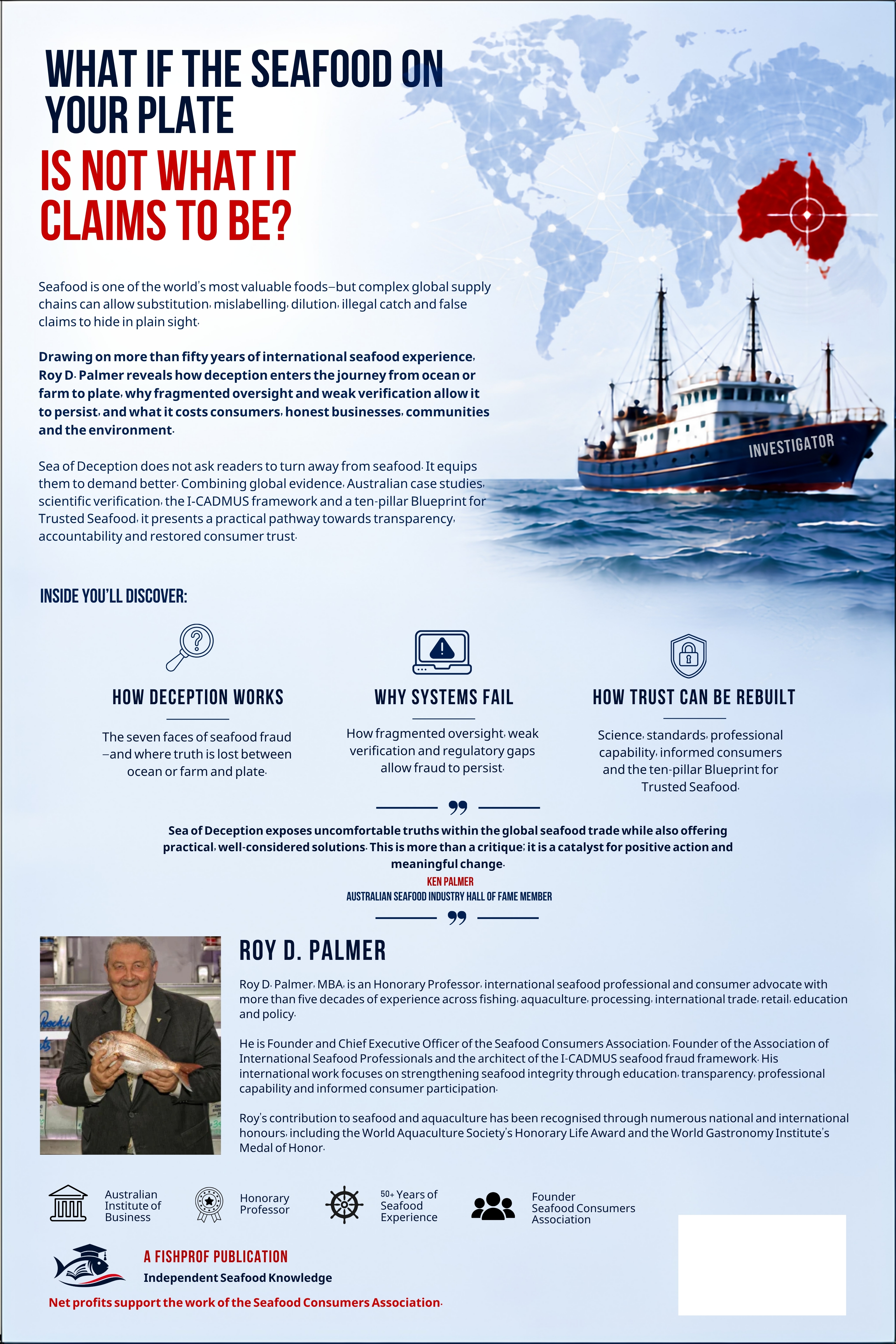
Sea of Deception is coming
What if the seafood on your plate is not what you were promised?
That question sits at the heart of Roy D. Palmer’s forthcoming book, Sea of Deception Understanding Seafood Fraud and Rebuilding Consumer Trust. Drawing on more than fifty years across the seafood value chain, the book examines how information about species, origin, production, legality, weight and authenticity can be lost, distorted or deliberately manipulated.
The aim is not to make people afraid of seafood. It is to help consumers, businesses and governments ask better questions, distinguish suspicion from proof and rebuild trust through clearer names, stronger traceability and accountable institutions.
Read the Sea of Deception launch blog
Want to get in first? Register your interest now to receive publication updates and be among the first to know when the book becomes available. Registration is not a preorder and does not require a purchase.
Register your interest through I-CADMUS
Four new SCA reads
Two trawl stories and one consumer test
One Australian trawl fishery has received national recognition for environmental performance. At almost the same time, another trawl sector has warned that imported fish sold under the valuable name Flathead is weakening demand for locally caught fish. The lesson is not that every trawl fishery is sustainable—or destructive. Each must be judged on evidence, while every seafood product must be identified accurately and its origin made clear.
Read What Two Trawl Stories Mean for Australian Seafood Consumers
Clean water begins well before the coast
A Phillip Island field trial of constructed floating wetlands shows how nature-based systems can reduce greenhouse gas emissions while improving wastewater quality. For seafood consumers, the significance reaches from inland treatment ponds to estuaries, shellfish-growing waters and aquaculture systems. Cleaner water at the source supports safer seafood, productive habitats and a more resilient Blue Economy.
Read Clean Water Lower Emissions and the Plate
The cost of confused food and health policy
The 270 billion Debacle asks why governments spend public money addressing chronic disease while health, food regulation and seafood policy often work at cross-purposes. With SCA preparing evidence for the national Women’s Health Submission, the central question is urgent: are women receiving clear, balanced and practical advice about seafood, omega-3 nutrition and healthy whole foods—or messages that create avoidable confusion and fear?
When taking four times the limit becomes very expensive
Channel 7 News Adelaide reported that a husband and wife were each fined $5,725 after being caught with more than four times the permitted Southern Calamari catch limit. The combined penalties totalled $11,450.
The case is a timely reminder that recreational bag and possession limits are not optional. They protect shared fisheries resources and preserve a distinction between fishing for personal use and operating outside the legitimate commercial system. Excess catch can undermine stock management, honest seafood businesses and public confidence—particularly if it enters informal or black-market trade.
A cheap seafood offer is not a bargain if the buyer cannot establish who harvested it, whether it was taken legally, how it was handled or where it came from. Consumers should buy from legitimate businesses, retain receipts where appropriate and avoid unlabelled seafood offered through informal channels.
Watch for the ABC investigation
Keep an eye on ABC’s 7.30 for its expected report on illegal fishing and Australia’s black-market seafood trade. The subject goes directly to the themes of Sea of Deception: illegal harvest, undisclosed supply chains, unfair competition, food-safety risks and the difficulty consumers face when seafood enters legitimate markets without reliable records.
We will comment further once the report has aired and its evidence can be assessed.
Consumer input wanted for two national submissions
SCA’s work over the coming week will concentrate on two important submissions. We want consumer experience—not only institutional views—to be part of both.
Australian Marine Parks
SCA is examining how proposed marine protection measures may affect seafood access, affordability, domestic production, import dependence, displaced fishing effort, regional communities and the environmental footprint of replacement supply. Marine conservation is essential, but decisions should account for food security and the consequences that move beyond the boundary of a park.
Send your experience or views to seafoodsdg@outlook.com with the subject heading MPA Submission.
Women’s Health
The Women’s Health Submission is due on 12 October. SCA is building the seafood case around maternal nutrition, omega-3 intake, pregnancy guidance, affordability, access to healthy whole seafood and the effect of confusing or overly cautious public messages. We welcome experiences from women, families, health professionals, educators and seafood consumers.
Send your experience or views to seafoodsdg@outlook.com with the subject heading Women’s Health Submission.
Useful contributions can be brief. Tell us what happened, why it mattered to you and what you believe government or industry should change. Please indicate if your comments may be quoted and whether you wish to remain anonymous.
Consumer check before buying seafood
- Ask for the species or accepted fish name—not only a broad marketing name.
- Check the country of origin and whether the product is wild caught or farmed.
- Buy through legitimate businesses that can explain their supply chain.
- Be cautious about cash-only, unlabelled or informal seafood offers.
- Report suspected illegal fishing or sales to the relevant fisheries authority; do not confront the seller.
Stay involved
Seafood consumers are not at the end of the supply chain. Our questions, purchasing choices and willingness to report concerns help determine what the market rewards.
Subscribe to SCA Insights for continuing news on seafood health, safety, sustainability, transparency and consumer rights.
Do not stop eating seafood. Understand it and demand better.
Comments
No comments yet.