
What a reported Sunshine Coast ciguatera incident teaches us about fish names, origin, traceability and consumer safety
| Case status: SCA has asked Queensland Health for verified information. The precise species, harvest origin, toxin findings and investigation outcome have not yet been publicly confirmed. |
A frightening illness—and an information problem
A Sunshine Coast couple has publicly reported becoming seriously unwell after eating fish sold as “cod”. Their reported symptoms—including gastrointestinal illness, fatigue, intense itching and the distinctive painful burning sensation caused by contact with cold water—are consistent with ciguatera fish poisoning.
The individual case must be investigated by the relevant health authorities. It would be wrong to identify the precise fish, its origin or the responsible point in the supply chain before that work is complete. But the incident already exposes an important consumer problem: “cod” is not one fish.
The word is applied in commerce to numerous unrelated species from very different environments. Without a precise species name and reliable harvest-origin records, consumers cannot properly understand what they are buying and investigators can face an avoidable obstacle when illness occurs.
What is ciguatera?
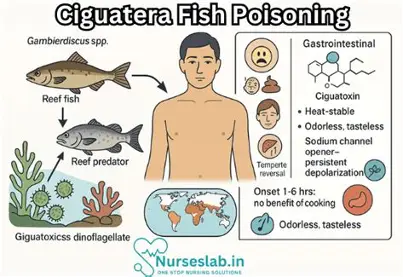
Ciguatera fish poisoning is caused by eating fish containing ciguatoxins. The toxins originate with microscopic marine organisms (dinoflagellates), including species of Gambierdiscus and Fukuyoa, and move through food webs. Smaller animals consume toxin-producing organisms; larger predatory fish then consume those animals. The toxins can become concentrated and transformed as they move through the food chain.
A fish carrying ciguatoxin may look, smell and taste entirely normal. The same species may carry ciguatoxin in one location at one time, but not in others. Cooking and freezing do not destroy the toxin. This makes prevention, accurate product identity and traceability especially important.
A recognised regional pathway
SCA Advisory Council member Dr Daryl McPhee, of Bond University, has documented relevant ecological history in his book Ecology and Environmental History of Noosa and the K’Gari[1] Coast and Noosa. His account describes Hervey Bay—and particularly Platypus Bay—as a recognised ciguatera-risk area. It explains a documented pathway in which toxin-producing dinoflagellates associated with seabed macroalgae enter the food web through small consumers, then fish such as Spotted Grunter, and ultimately larger predators such as Spanish Mackerel.
That regional evidence does not establish the origin or species involved in the current Sunshine Coast incident. It does show why ciguatera risk is geographically and ecologically specific. A species can present a higher risk in one location and a lower risk elsewhere.
Queensland fisheries rules provide a practical example of prevention: Spanish Mackerel cannot be taken from Platypus Bay because of ciguatoxin contamination risk.
The Sydney Fish Market lesson: control the risk before sale
Sydney Fish Market’s Seafood Handling Guidelines provide some of the clearest operational advice available to seafood businesses. They do not rely on a retailer recognising a toxic fish by sight—because that cannot be done. Instead, they manage the risk through purchasing controls based on species, harvest area and fish size.
The current guidelines include a schedule of prohibited species, prohibited source areas and maximum size limits for identified high-risk species. They require rejection of specified products, prohibit relevant products from identified high-risk areas, and advise removal of livers and organs from high-risk species before sale because toxins may be more concentrated in those tissues.
For Queensland product, the schedule includes maximum limits for several higher-risk groups, including Coral Trout, Reef Cods, Spanish Mackerel, Trevallies and Tuskfish. These are commercial risk controls, not a guarantee that every smaller fish is toxin-free. The schedule itself warns that it may be amended, so businesses must use the latest version rather than copying limits permanently into an unattended food-safety plan.
| Retailer principle: Know the exact species. Know the harvest area. Check current high-risk restrictions and size controls. Keep the supplier and lot records. Reject product that falls outside the approved purchasing specification. |
Why “cod” is not enough
Queensland Health lists reef cods among the warm-water reef fish that may be implicated in ciguatera. It also expressly excludes cold-water fish such as imported Hoki and hake from its reef-fish definition for ciguatera surveillance. That distinction matters.
Calling a fish simply “cod” can collapse very different species and risk profiles into one vague commercial description. It can also fuel incorrect public speculation after an incident. The name on the ticket, invoice and menu should be the Australian Standard Fish Name (AS5300), supported upstream by the scientific name where necessary.
Accurate naming does not prevent ciguatera itself. It makes risk assessment, trace-back, withdrawal, investigation and consumer communication more effective. Food safety and seafood authenticity meet at exactly this point.
What seafood businesses should do
- Purchase warm-water reef fish only from approved suppliers with reliable traceability.
- Record the Australian Standard Fish Name, scientific name where available, harvest location, supplier, date, lot or batch and fish weight.
- Use current jurisdictional rules and current industry guidance for prohibited species, source areas and size limits.
- Do not accept “cod”, “reef fish” or another generic description when it prevents a meaningful species and origin assessment.
- Retain invoices, carton labels and other source records so affected product can be traced and withdrawn rapidly.
- If illness is reported, preserve any remaining raw fish, cooked meal, packaging and purchase records; isolate related stock and contact the relevant food regulator or public health unit immediately.
- Do not assume that cooking, freezing, smell, appearance or a small taste test will make suspect fish safe.
What consumers should know
- Ask for the precise fish name and country or area of origin, particularly for warm-water reef fish.
- Avoid consuming large warm-water predatory reef fish and follow local advice about species and fishing areas.
- Avoid the head, roe, liver and other viscera of warm-water reef fish, where toxin may be more concentrated.
- If symptoms develop, stop eating the fish, preserve leftovers and packaging, and seek prompt medical advice.
- Call 000 for a medical emergency. The Poisons Information Centre is available on 13 11 26; Queenslanders can also call 13 HEALTH on 13 43 25 84.
Testing is improving, but prevention remains essential
FRDC-supported research has been developing and evaluating methods to detect ciguatoxins, including work involving the University of Technology Sydney, Sydney Fish Market, the University of Tasmania and New Zealand’s Cawthron Institute. The purpose is to map risk more effectively and support improved management strategies.
This research is important, but routine, rapid and universally available commercial testing is not yet a substitute for sound purchasing controls. Such testing has been the focus of much research over a long period of time, but a practical and reliable commercial rapid assessment tool has proven to be elusive with the very small volumes of toxin that illicit a clinical response one of the key reasons for this. The practical defence remains avoidance of known high-risk combinations of species, size and location—backed by accurate names and records that follow the fish through the supply chain.
What SCA has done
The Seafood Consumers Association Ltd has written to the Sunshine Coast Public Health Unit and copied relevant Queensland Health food-safety and epidemiology teams. We have requested de-identified confirmation of the species, harvest origin, supply pathway, any toxin or species testing, stock withdrawal and the investigation status.
SCA will update this article when verified findings are available. Until then, the lesson is not that every fish called cod is dangerous. The lesson is that consumers, retailers and health investigators deserve names and records precise enough to identify the fish and assess the risk.
| SCA position: Fish naming is not merely a marketing issue. When species and origin affect risk, accurate identity becomes part of food-safety infrastructure. |
Sources and further information
Queensland Health — Ciguatera fish poisoning: https://www.health.qld.gov.au/cdcg/index/ciguatera-fish-poisoning
SafeFish — Ciguatera Fish Poisoning Fact Sheet: https://safefish.com.au/report/ciguatera-fact-sheet/
FRDC — Fish toxin tests to track ciguatera risk: https://www.frdc.com.au/fish-toxin-tests-track-ciguatera-risk
Sydney Fish Market — Seafood Handling Guidelines: https://www.sydneyfishmarket.com.au/quality/
Queensland Government — East coast Spanish Mackerel fishery and Platypus Bay closure: https://www.business.qld.gov.au/industries/farms-fishing-forestry/fisheries/commercial/profile/line/spanish-mackerel
Regional ecological context supplied with permission by Dr Daryl McPhee, Bond University, from Ecology and Environmental History of the K’Gari Coast and Noosa.
[1] Environmental History and Ecology of Noosa and the K’Gari Coast – Boolarong Press
Comments
No comments yet.