
This week’s theme: Trusted seafood is built through clear information, capable people and consumers willing to ask questions.
1. Country-of-Origin Labelling starts: a win, but only the beginning
From 1 July, hospitality businesses serving seafood for immediate consumption must tell customers whether it is Australian (A), Imported (I) or Mixed origin (M). This applies to restaurants, cafés, pubs, clubs, fish-and-chip shops, takeaways and food trucks.
SCA welcomes the change. It gives diners a practical right to ask where seafood comes from. But A/I/M is a starting point—not a complete transparency system. Origin alone does not identify the species, prove a regional claim, explain production method or guarantee that the menu description is accurate.
SCA’s next-stage priorities are:
- Use approved Australian Fish Names Standard names at all times, with the supplier invoice as the point of reference.
- Provide clear and truthful menu descriptions, particularly for species, regional, farm and quality claims.
- Publish annual compliance information so consumers and responsible businesses can see how the rules are being implemented nationally.
Consumer action: Look for A, I or M before ordering. If it is missing, politely ask the venue how it is meeting the requirement. Then ask: “What species is it?”
Read SCA’s media release: “New Menu Labels Are a Win for Seafood Consumers—But They Are Only the Beginning.” For the official guidance, see business.gov.au.
2. Australian Fish Names: the South American Duckbill decision matters
The Australian Fish Names Committee (AFNC) is expected to consider the outcome of the appeal process relating to the proposed name South American Duckbill later this month. The application arose because the imported species has too often been marketed in ways that can confuse consumers and place Australian flathead fishers at a disadvantage.
SCA’s position is straightforward: consumers deserve truthful names and businesses need a clear, practical reference point. The Australian Fish Names Standard is designed to reduce confusion from invoice to menu. The current process should now reach a timely, transparent conclusion.
Why it matters: Country-of-origin information is useful, but correct species naming is the stronger protection against substitution and misleading descriptions.
3. Training connectivity: SCA, VIITE and AITC
A positive Australian development is the growing connection between the Seafood Consumers Association, VIITE and the Australian Institute of Technical Chefs (AITC). SCA already has an MoU with VIITE, and AITC now has MoUs with both organisations.
This creates a practical pathway linking consumer expectations, seafood integrity and traceability education with the chefs and hospitality professionals who prepare and communicate seafood to the public. Early discussions will focus on better supplier records, correct fish names, clearer origin information, more informed menus and staff who can answer consumer questions with confidence.
4. Food integrity: a global consumer issue
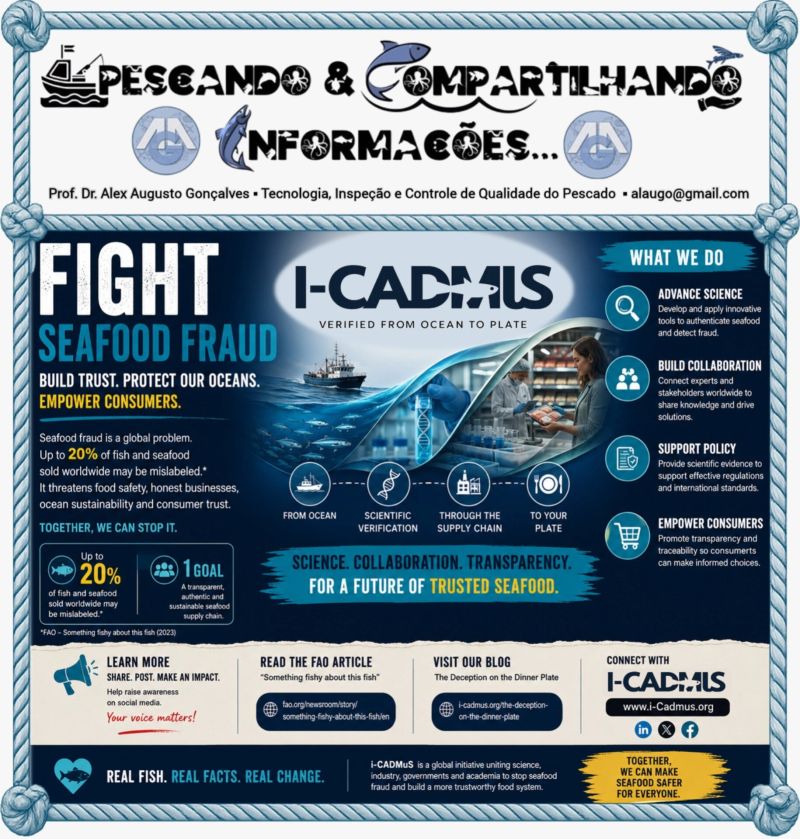
The FAO GLOBEFISH webinar on aquatic food fraud has reinforced that seafood fraud affects consumer confidence, value and fair competition. Education and professional capability matter alongside enforcement. This is central to SCA’s developing I-CADMUS work and aligns naturally with the SCA–VIITE–AITC training opportunity.
The webinar recording is available through the FAO GLOBEFISH YouTube channel (https://youtu.be/xWMVkB5wJdk).
5. Seafood World Cup: quarter-final seafood challenges
The AITC–SCA Seafood World Cup moves into the quarter finals. This week’s seafood matchups are France (oysters) v Morocco (sardines); Norway (cod) v England (haddock); and Spain (red shrimp) v Belgium (mussels).
Have your say: Email your winners to seafoodsdg@outlook.com. See the quarter-final infographic and watch for next week’s semi-final challenge.
6. Ocean and supply watch
Extreme heat is a reminder that cold-chain resilience matters to freshness, spoilage prevention and reliable seafood supply. SCA will continue to watch credible developments in this area rather than rely on unverified operational claims.
Responsible aquaculture also remains part of the food-security solution. Long-term breeding and production improvements can support supply, affordability and feed efficiency, provided genetic diversity, fish welfare and disease resilience remain central.
In South Australia, the harmful algal bloom remains a consumer-confidence issue. The priority is transparent monitoring, timely public advice and clear communication about seafood safety—not alarm.
Also worth reading on the SCA website
- Britain’s Octopus Boom — A Warning and an Opportunity from a Warming Sea
- Port Phillip’s Sail Traders — When the Bay Was Melbourne’s Working Highway
- Whales, Citizen Science and Blue Planet III
SCA weekly view: Consumers now have more information—but still need better information. Honest names, clear origin, capable people and evidence-based systems remain the foundation of trusted seafood.
Consumer First. Honest names. Clear origin. Trusted seafood.
Comments
No comments yet.