
Featuring New Monthly Feature - Roy’s Consumer Perspective (Monthly – June/July)
Country of Origin Labelling: Now Consumers Must Use It
From 1 July 2026, Australian hospitality businesses serving seafood must tell customers whether seafood is Australian (A), Imported (I) or Mixed (M). This is a major step forward for consumer transparency. (business.gov.au)
But laws only work if consumers use them and governments enforce them!
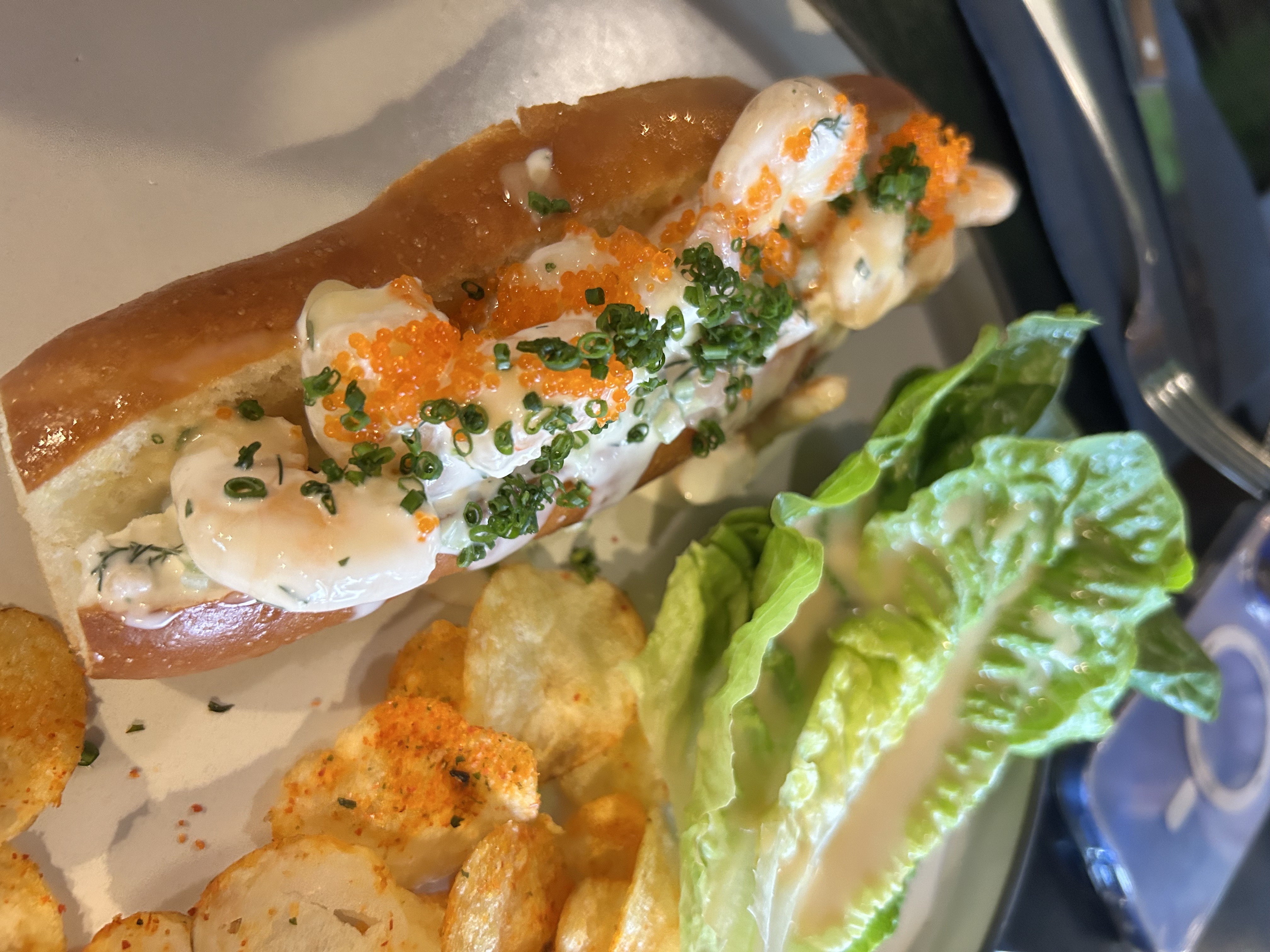
This week I had dinner at a hotel and noticed several seafood menu descriptions that raised questions — not necessarily because they were deliberately wrong, but because they showed how easily seafood information can become unclear.
“Red Snapper” appeared on the menu. Is that truly the species being used? “Tiger King Prawns” also appeared — yet Tiger Prawns and King Prawns are different seafoods. “Barra” may be familiar shorthand, but the proper standard name is Barramundi. If a menu claims, “Humpty Doo Barramundi”, that should be verifiable on the supplier invoice. Oysters, too, deserve better than anonymity: species, growing area and farm information matter to consumers who love oysters.
A consumer also advised SCA that some well-known venues still appear not to be clearly using the new AIM labelling or are using “I” without “A” even where a local geographic origin is stated.
The message is simple: consumers should politely ask questions.
What species is it?
Is it Australian, imported or mixed?
Can the origin claim be verified?
Is the fish name correct?
Does the menu match the supplier invoice?
This is not about attacking restaurants. It is about helping good businesses get it right and helping consumers make informed choices.
Every seafood menu is a promise.
Every promise should be capable of being verified.
Australian Seafood Leads This Week
The past week highlighted several important developments for Australian seafood consumers—from a major Parliamentary inquiry in Western Australia, to ongoing food security discussions following the release of the FAO SOFIA Report, continued concerns about avian influenza, and growing recognition that consumers deserve a stronger voice in Australia's seafood future.
Australian News
WA Demersal Inquiry Opens – Consumers Finally Have a Voice
One of the biggest seafood developments this week was the announcement by the Western Australian Parliament of a formal Parliamentary Inquiry into the impact of the WA demersal fishing restrictions.
Importantly, the Terms of Reference extend well beyond fish stocks.
The Inquiry will examine:
- the need for a long-term fisheries plan;
- impacts of marine parks;
- renewable energy developments;
- shark depredation;
- illegal fishing;
- seismic exploration; and
- whether DPIRD has sufficient resources.
Public submissions are now open until 3 August 2026.
SCA View
This is an opportunity that seafood consumers should not ignore.
For too long fisheries debates have largely focused on commercial and recreational sectors.
Consumers—the people who ultimately pay for seafood and rely on healthy fisheries—also deserve to be heard.
The Inquiry should examine not only sustainability but also:
- seafood affordability;
- food security;
- local seafood supply;
- consumer access;
- transparency.
Healthy fisheries should ultimately produce healthy seafood for Australian consumers.
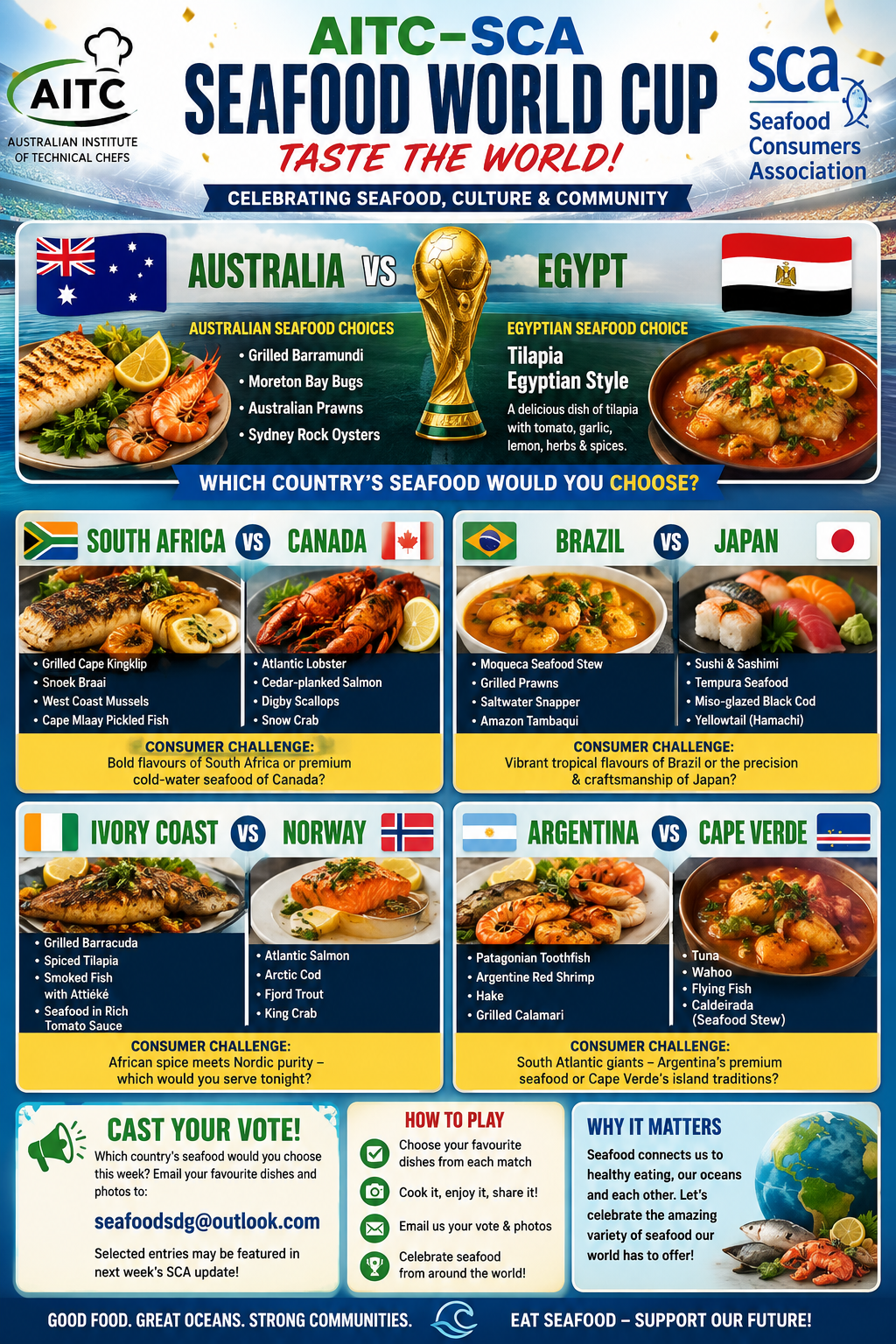
Seafood World Cup 2026 - Joint Initiative of the Australian Institute of Technical Chefs (AITC) & Seafood Consumers Association (SCA)
As the FIFA World Cup moves into the knockout stages, our Seafood World Cup continues to celebrate the wonderful seafood traditions of participating nations.
This week's feature matches offer some fantastic culinary contrasts, especially as Australia takes on Egypt in a cut and thrust do or die game!
Others we have chosen to highlight are South Africa vs Canada; Brazil vs Japan; Ivory Coast vs Norway and Argentina vs Cape Verde
Email your favourite dishes and photos to: seafoodsdg@outlook.com
Selected entries may be featured in next week's Seafood Consumers Association update.
Australia versus the World – SOFIA 2026
This week SCA released its comparison between Australia's seafood sector and the FAO's latest State of World Fisheries and Aquaculture (SOFIA 2026).
The comparison shows Australia performs well in many areas, but significant opportunities remain.
Australia should now focus on:
• reducing dependence on imported seafood
• increasing domestic seafood production
• expanding sustainable aquaculture
• developing freshwater food production
• improving seafood affordability
• strengthening seafood food security
The comparison also reinforces SCA's proposal for a Freshwater Aquatic Food Centre of Excellence (FAFCoE). NO VIRUS IN AUSTRALIAN WATERS!
Freshwater species—including carp and yabbies—represent underutilised food resources that could contribute significantly to regional jobs and Australia's future food security.
Yabbies – Australia's Forgotten Seafood Opportunity
One of the week's more positive stories has been renewed interest in Australia's freshwater yabbies.
Often overlooked, yabbies represent:
- high-quality Australian protein;
- regional business opportunities;
- freshwater aquaculture diversification;
- premium local food.
Australia has enormous untapped freshwater food potential.
SCA believes freshwater seafood deserves far greater recognition within national food security policy.
Bird Flu Update
Highly Pathogenic Avian Influenza (H5) continues to be closely monitored following detections in wild birds.
There remains no evidence that properly prepared seafood presents a food safety risk from these detections.
However, the outbreak highlights how interconnected Australia's food systems have become.
Biosecurity remains everyone's responsibility.
Around Australia
SCA continues monitoring:
- harmful algal blooms in South Australia;
- fisheries allocation reforms;
- seafood affordability;
- Country of Origin Labelling implementation;
- Australian Fish Names Standard developments.
International Highlights
Seafood Fraud Now Receiving Global Attention
One of the most encouraging developments this week is that seafood fraud is receiving increasing international media attention following the recent FAO seafood fraud webinar.
Seafood Source reported that FAO estimates seafood fraud may affect up to 20% of global seafood trade.
This reinforces exactly why SCA has invested so heavily in:
- Sea of Deception
- I-CADMUS
- consumer education
- university-aligned training.
Seafood fraud is no longer regarded simply as an industry issue.
It is increasingly recognised as a global consumer issue.
China Highlights Future Feed Challenges
The International Fishmeal and Fish Oil Organisation (IFFO) conference in China highlighted growing concern about future supplies of marine ingredients used in aquaculture feeds.
China remains central to global seafood production.
Future shortages of fishmeal and fish oil could influence:
- aquaculture costs;
- seafood prices;
- alternative feed development;
- food security.
Consumers may ultimately experience these pressures through seafood prices and product availability. We have a follow up blog coming out this week.
FAO SOFIA – Blue Transformation Continues
The FAO continues to promote its Blue Transformation agenda aimed at:
- increasing sustainable aquatic food production;
- improving nutrition;
- reducing waste;
- strengthening aquatic food systems.
Australia is well placed to contribute—but must continue investing in domestic seafood production, innovation and consumer confidence.
SCA Activities
This week SCA continued work on several major initiatives:
- Double dipping on Seafood Sustainability costs
- Sea of Deception (book)
- I-CADMUS global seafood fraud framework
- FAFCoE development including water quality issues.
- Weekly consumer seafood intelligence reports
- Consumer comparisons between Australia and the world under SOFIA 2026
Our objective remains simple:
To ensure seafood consumers have access to seafood that is safe, honestly labelled, affordable, sustainable and supported by trustworthy information.
Consumer Thought of the Week
Consumers are not the last link in the seafood chain—they are the reason the chain exists.
Every fisheries policy, seafood business, aquaculture investment and food safety system ultimately exists to serve the consumer.
That perspective deserves a stronger voice.
Until next week…
Comments
Vilas
27 Jun 2026, 08:22 PM
Hi,
I liked the consumer thought of the week.
Cannot express the feedback in few words ...
Thank you