

The release of the FAO's State of World Fisheries and Aquaculture (SOFIA) 2026 report provides a timely opportunity to compare Australia's seafood performance with global trends and ask an important question:
Are we doing enough to secure Australia's seafood future?
The answer is both encouraging and challenging.
On one hand, Australia has one of the world's most respected fisheries management systems, a growing aquaculture sector and abundant marine resources. On the other hand, we remain heavily dependent on imported seafood, face increasing food security risks, and continue to underutilise many opportunities that could strengthen domestic seafood production.
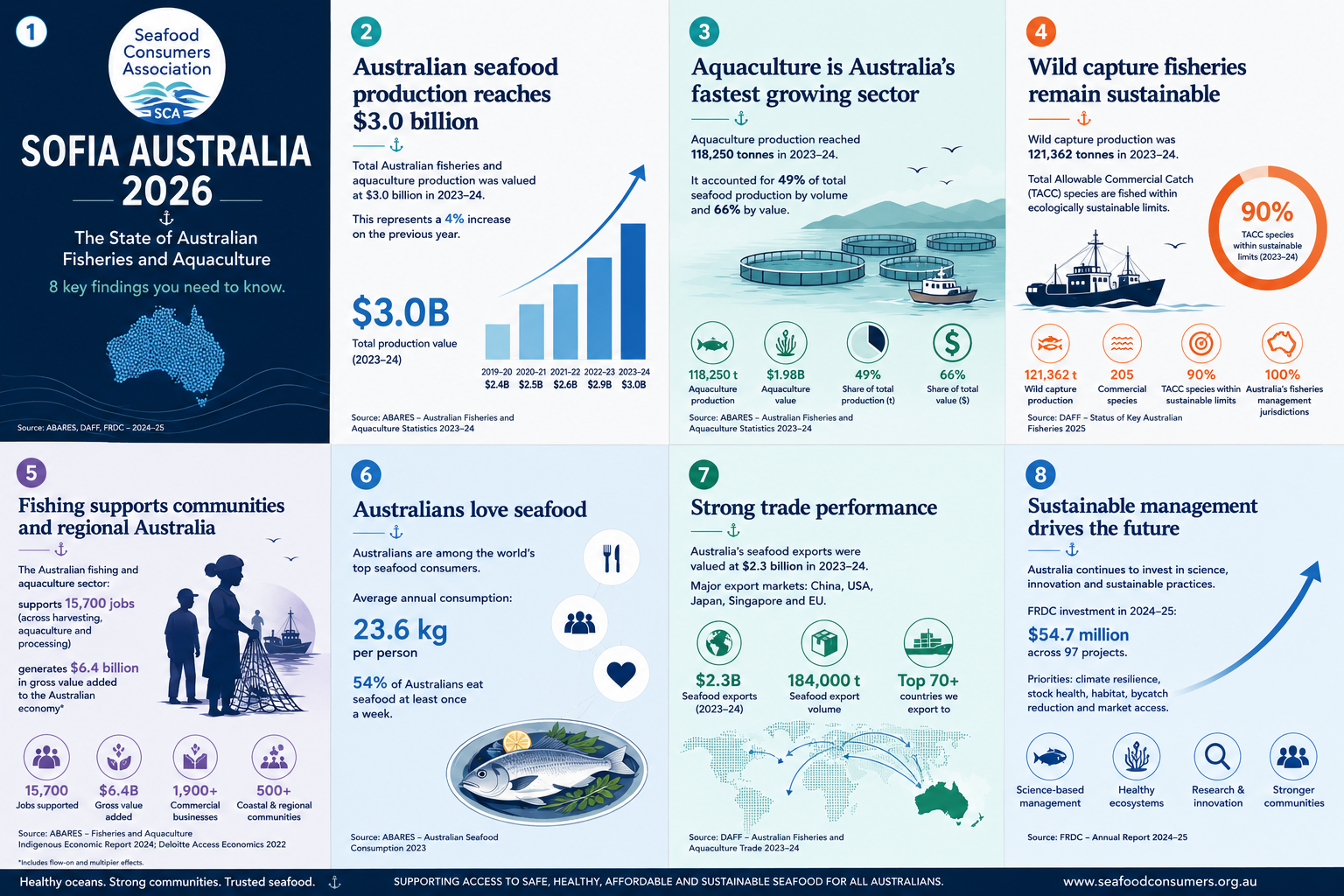
Be it political will, paralysis by bureaucracy, industry apathy – you can decide but the comparison between the FAO's global SOFIA report and the Seafood Consumers Association's SOFIA Australia infographic highlights both our strengths and our challenges.
The World is Producing More Seafood Than Ever
Globally, seafood production reached a record 235 million tonnes, with aquaculture now producing more than half of all aquatic animal products consumed worldwide.
The message from FAO is clear.
The future growth of seafood will come primarily from aquaculture.
Wild capture fisheries have largely stabilised, with sustainability becoming an increasingly important challenge. While many fisheries remain well managed, global marine stock sustainability has declined over time and remains a concern for governments, industry and consumers alike. Australia still has wild capture fish opportunities as there are many great species which go unfished due to poor marketing.
At the same time, seafood has become one of the world's most important food sources, providing critical protein and nutrition to billions of people.
For Australia, these global trends matter because we are part of an increasingly interconnected seafood market.
Australia Performs Well — But Relies Heavily on Imports
Australia's seafood sector continues to perform strongly.
Production value exceeds $3 billion annually, our fisheries are generally well managed, and aquaculture is growing rapidly.
Australia also enjoys a strong international reputation for seafood quality, sustainability and food safety.
Yet there is a contradiction.
Despite being surrounded by ocean and possessing one of the world's largest Exclusive Economic Zones, Australia imports a significant proportion of the seafood consumed by its population.
This creates vulnerability.
Global supply chain disruptions, geopolitical tensions, disease outbreaks, climate events and trade restrictions can all impact seafood availability and affordability.
If the COVID years taught us anything, it is that food security cannot be taken for granted.
Food Security Must Become a National Priority
One of the strongest messages arising from the comparison between global and Australian data is the need for a stronger focus on seafood food security.
Australia has the capability to produce more seafood domestically.
The question is whether we have the policy settings to support that growth.
Too often seafood is absent from broader food security discussions despite its recognised nutritional benefits and contribution to healthy diets.
Seafood should not be viewed simply as a premium product.
It is an essential food source that contributes high-quality protein, omega-3 fatty acids and important micronutrients.
A national seafood strategy focused on increasing domestic production, improving affordability and encouraging consumption would strengthen Australia's food security position considerably.
Aquaculture Will Drive Future Growth
The FAO report confirms that aquaculture is now the world's growth engine.
Australia's figures tell a similar story.
Aquaculture already contributes the majority of seafood production value and continues to expand.
Atlantic Salmon, Oysters, Prawns, Barramundi, Mussels and other farmed species are helping meet consumer demand while reducing pressure on wild fisheries. Some states are doing far better than others.
The challenge for Australia is ensuring that aquaculture growth continues to be supported by science, innovation and appropriate regulation (national rather than state/territory would be better!).
Consumers benefit when more seafood becomes available, affordable and accessible.
Freshwater Fisheries Offer Untapped Opportunities
One area receiving little national attention is freshwater seafood production.
Australia's rivers, lakes and reservoirs have significant untapped potential.
This is one reason the Seafood Consumers Association has proposed the establishment of a Freshwater Aquatic Food Centre of Excellence (FAFCoE). It helps eliminate an invasive species (no virus can ever resolve that) and boosts our freshwater aquatic opportunities in rural/regional areas not only boosting food security but well-being, nutrition and jobs.
Rather than viewing species such as carp solely as environmental problems, Australia should also examine opportunities to convert underutilised freshwater resources into food, feed, fertiliser, omega-3 products and other value-added products.
The objective is simple:
Transform a challenge into an opportunity.
FAFCoE could help support regional jobs, strengthen food security, improve resource utilisation and create new industries while contributing to environmental outcomes. SCA cannot believe that so much PUBLIC money has been spent on a virus when little or nothing spent on proactive ways of attacking the problem.
Supporting Industry Means Supporting Consumers
Consumers often hear debates about fisheries management, aquaculture approvals and environmental regulation.
What is often overlooked is the direct connection between industry success and consumer outcomes.
When seafood businesses face excessive costs, delays or uncertainty, those impacts eventually flow through to consumers in the form of higher prices and reduced availability.
Supporting responsible seafood production is not about choosing industry over consumers.
It is about recognising that consumers need a strong, sustainable and innovative seafood sector if they are to enjoy affordable access to seafood.
Good policy should support both.
Trust Remains Essential
The future of seafood is not only about production.
It is also about confidence.
Consumers need confidence in food safety.
Confidence in sustainability.
Confidence in seafood labelling.
Confidence in origin claims.
Confidence that they are receiving value for money.
This is why transparency, traceability and seafood fraud prevention remain important priorities for the Seafood Consumers Association.
The world's seafood sector is growing rapidly.
Australia has the resources, expertise and reputation to be a leader.
But leadership requires action.
Looking Ahead
The comparison between SOFIA 2026 and Australia's seafood performance tells a positive story—but also highlights opportunities.
Australia should focus on:
- Strengthening seafood food security.
- Reducing excessive reliance on imports.
- Expanding sustainable aquaculture.
- Developing freshwater seafood opportunities through FAFCoE.
- Supporting innovation and investment.
- Improving consumer trust and transparency.
- Encouraging greater seafood consumption for health and nutrition.
The world is moving forward.
Australia has the opportunity to do the same.
The Seafood Consumers Association believes the goal should be clear:
A future where every Australian has access to safe, healthy, affordable, sustainable and honestly labelled seafood.
That is a future worth investing in.
Comments
No comments yet.