
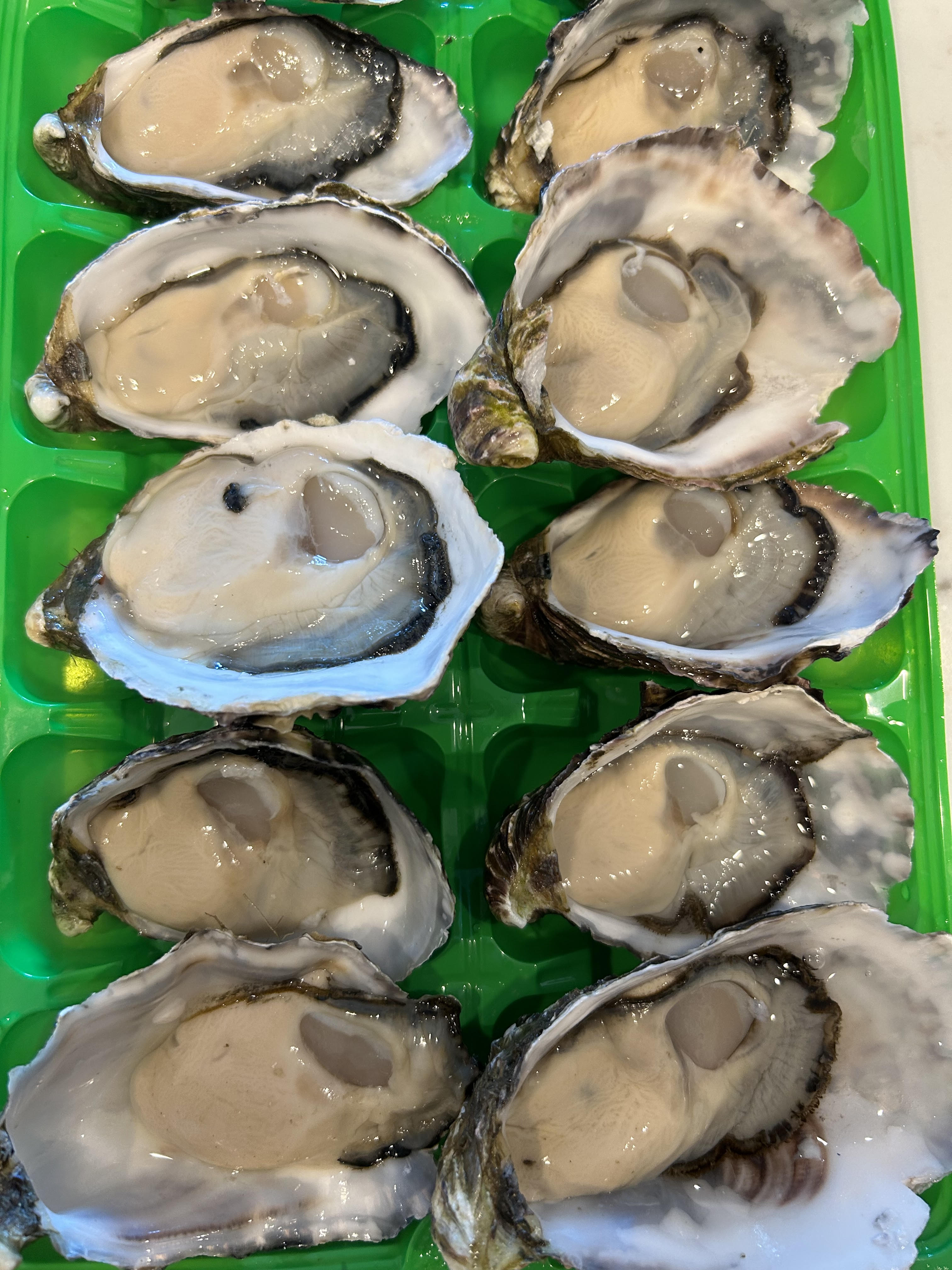
For many Australians, Christmas and New Year celebrations are incomplete without oysters. They’re festive, local, nutritious, and deeply woven into our coastal food culture. But behind that platter of glistening shells lies a complex story about production, species choice, and environmental policy — particularly in Victoria.
How many oysters do Australians eat over Christmas?
Australia produces around 11 million dozen oysters annually (about 132 million individual oysters). Industry estimates suggest that 15–18% of annual oyster sales occur during the Christmas–New Year period, driven by family celebrations, hospitality demand, and seafood-focused festivities.
That means Australians likely consume between 1.65 and 2.0 million dozen oysters over just a few festive weeks — roughly 20–24 million oysters nationwide.
Where do those oysters come from?
Oyster production (and festive consumption) is not evenly spread across the country.
• New South Wales dominates, accounting for roughly 60–65% of Christmas oyster sales, largely due to Sydney Rock oysters.
• South Australia contributes about 15–20%, primarily Pacific oysters.
• Tasmania supplies 10–15%, also mostly Pacific oysters.
• Victoria and Western Australia together account for less than 8%, reflecting smaller production bases.
In simple terms, most Christmas oysters eaten in Australia come from NSW, SA, and Tasmania.
Sydney Rock vs Pacific oysters: what’s on the plate?
Over the festive season, oysters break down roughly as:
• Sydney Rock oysters: ~64–67%
• Pacific oysters: ~33–36%
Sydney Rock oysters are native to Australia and are synonymous with NSW estuaries. Pacific oysters, by contrast, are an introduced species but one that now underpins the oyster industries of South Australia and Tasmania, and parts of NSW.
So why does Victoria stand apart?
Victoria treats Pacific oysters as a marine pest; there is a history of environmental caution.
Pacific oysters (Crassostrea gigas) were introduced to Australia in the mid-20th century. Victoria saw the wild population establish themselves aggressively in Port Phillip Bay and surrounding coastal waters. Unlike todays managed aquaculture environments, these oysters began to:
• Colonise rocky reefs and intertidal zones
• Outcompete native species
• Alter natural habitats
• Create navigation and safety hazards in some areas
As a result, Victoria classified Pacific oysters as a declared marine pest, making it illegal to farm or intentionally propagate them in Victorian waters.
Other states took a different path - they had the same species but responded differently:-
• South Australia and Tasmania adopted strict biosecurity and farming controls, focusing on:
• Hatchery-based seed
• Triploid (sterile) oysters
• Contained lease systems
• These states saw Pacific oysters not as a threat, but as a commercial opportunity:
• Faster growth
• Consistent size
• Strong consumer demand
Today, Pacific oysters underpin multi-million-dollar regional industries in SA and Tasmania, supporting coastal jobs and export markets. The Victorian seafood industry is the largest processor of Pacific Oysters, but production is reliant on SA and Tasmania.
NSW has a mixed model. NSW primarily protects and promotes Sydney Rock oysters, a culturally and ecologically significant species. However, Pacific oysters are permitted in certain areas under controlled conditions — particularly where environmental risk is considered manageable.
Is Victoria’s approach “right” or “wrong”?
From a consumer perspective, this isn’t about blame — it’s about policy choices reflecting local ecosystems and risk tolerance.
Victoria prioritised:
• Protection of native habitats
• Prevention of further spread
• Environmental caution over commercial expansion
Other states prioritised:
• Regional economic development
• Controlled aquaculture systems
• Managing risk rather than prohibiting activity
Both approaches have trade-offs, but it really shows Victoria a risk averse state. What matters, especially for consumers, is that these decisions shape what seafood is available, how much it costs, and where it comes from.
Why this matters to seafood consumers
Oysters are a public resource, grown in shared coastal waters and governed by public policy. Yet consumers, the people who ultimately fund the industry, are rarely at the decision-making table. WHY?
Consumers need to be part of the process to get an understanding about:
• why some oysters are available in one state but not another,
• how environmental risk is assessed,
• and how food policy intersects with environmental conservation.
If consumers were at ‘the table’ consumers would engage more meaningfully with fisheries management and everyone would win.
At SCA, we believe:
Consumers are the community — and it’s their resource.
Whether it’s oysters at Christmas or broader fisheries/aquaculture policy, consumer voices deserve representation alongside government, industry, and scientists.
The takeaway:
• Australians eat up to 2 million dozen oysters over Christmas and New Year.
• Sydney Rock oysters dominate, but Pacific oysters are essential to national supply.
• Victoria’s pest classification reflects environmental caution, not seafood quality.
• Other states embraced Pacific oysters under strict management frameworks.
• Consumers have a stake — and a right — to be informed and involved.
Because the future of seafood isn’t just about what’s farmed — it’s about who gets a say.
Comments
No comments yet.